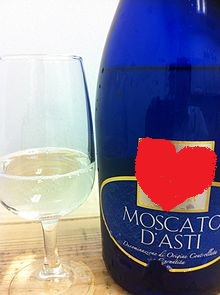
Moscato is both the Italian name for the Muscat vine variety group and the name for specific varietal slightly sparkling sweet wines, with underlying acidity, produced with Muscat grapes. “Moscato” on Italian wine labels relates to a varied range of wines, from non-sparkling dry whites to fully sparkling wines to very sweet, dessert wines. The wines usually have floral aromas of orange blossom and golden or white peaches.
Muscat is one of the oldest grapes used by man to make wine. Ancient Greeks and Romans cultivated these vines and produced renowned wines from them. Several varieties of Muscat are used, but the best quality wines are made from Muscat Blanc à Petit Grains, also known in Italy as Moscato di Canelli. It is Italy’s fourth most planted white variety. Muscat family vines are widely planted in several countries. Yet, the type most commonly planted in California is Muscat of Alexandria, quite a less significant grape.
Some of these wines, especially those produced in Italy’s Asti region, are of excellent quality. However, others are appalling, in particular those produced by gargantuan wine industry multinationals. The finest lightly sparkling bottles come from the area around the town of Asti in Italy’s Piedmont. They are called “Moscato d’Asti”, and they are prepared by halting fermentation (rapidly lowering its temperature) once the alcohol level grows to 5.5%. Their natural fizziness originates from the carbon dioxide released during fermentation. The wine is then filtered to remove yeasts, so to prevent further fermentation in the bottle.
Moscato is a relatively inexpensive, lightly sparkling, sweet wine with good acidity. It can be enjoyed as an aperitif, with pâté or similar food or as a complement to dessert. It also supports spicy Asian dishes, savoury meals, tapas and cheese.
The best, multifaceted and food friendly Moscatos are those produced in Italy, again in the Moscato d’Asti area. Moscato d’Asti should not be confused with Asti Spumante, the latter being a fully sparkling and higher alcohol sweet wine also made from Muscat in Asti. “Spumante” on the label is the Italian word for sparkling (“foamy”). The region’s best and ripest grapes are used for Moscato d’Asti.
A shortlist of some of the best Moscato names would include: Saracco, Ceretto, Bera, Fratelli Barale, La Spinetta, Marchesi di Grésy, and Vietti. Please note that the finest producers of Moscato d’Asti often also produce great Piedmontese red wines (Barolo and Barbaresco); this makes enticing looking for both.
Americans are building a powerful sweet wine trend. US Sales of Moscato wine rose in the past several years, especially among relatively young buyers (21 to 30 years of age). Nielsen reports for wine consumption in the US say that sales of Moscato there increased over 200% between 2009 and 2011, and that they rose again by 78% in 2011, exceeding $300 million in sales that year. Moreover, Moscato has become a huge cultural phenomenon in the rap and hip-hop music worlds in the past years, with Moscato being mentioned in several big hit songs. Sales of Italian Moscato d’Asti in the US rose by near 50% during that time. However, US giant wine company Gallo, commands the American market in volume terms with around a 43% share (selling both Barefoot and Gallo Family bottlings), while Trincher’s Sutter Home Brand has about a 27% share.
The amount of Moscato grown in Italy is obviously limited. Big wine firms (Americans in particular) have been purchasing it with increasing “thirst”, consequently raising prices for the grape to their highest level ever. Moscato vines are also rapidly and extensively being planted in Australia, Chile, France and California’s Central Valley, but those new plantings will take years to come into production. To create the big quantity asked by the American market, mammoth producers are reportedly adding wines from neutral white varieties such as French Columbard (and others) to their Muscat bottlings, thus diluting the amount of real Moscato in the bottles being sold.
 gourmettino